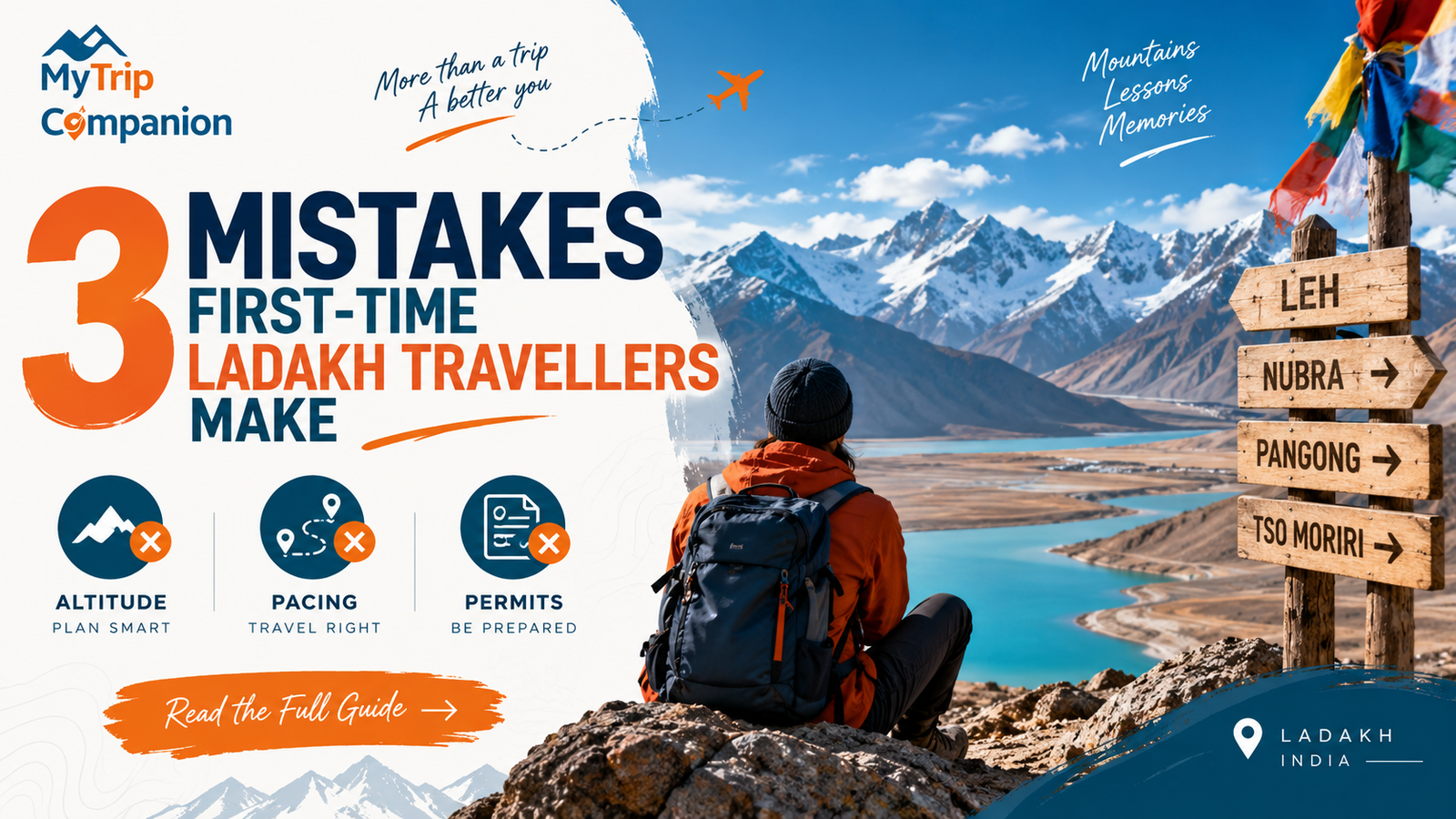

I have been sending travellers to Ladakh for over fifteen years, and I can usually tell within one phone call whether someone is going to have a good first trip or a rough one. It rarely comes down to budget. It comes down to three decisions people make while planning, usually weeks before they ever see a mountain.
Ladakh punishes a rushed plan more than any other destination in India. The scenery is forgiving. The altitude is not. What follows are the three mistakes I see most often from first-timers, why they happen, and what to do instead.
Mistake 1: Treating your first day in Leh as a sightseeing day
This is the big one. If you fix nothing else on this list, fix this.
A morning flight from Delhi puts you in Leh in about seventy-five minutes. You leave a city at roughly 216 metres and land at 3,500 metres before your breakfast has settled. Your body has no way to adjust that fast. There is roughly forty percent less oxygen in each breath you take at Leh airport than there was at the boarding gate.
Almost every first-timer lands, drops their bags, feels perfectly fine, and heads straight out to Shanti Stupa and Leh Palace. By evening the headache starts. By night they cannot sleep, cannot eat, and are wondering whether to cut the trip short. I have had guests who lost three days of a seven-day trip because of what happened in the first six hours.
What to do instead
Block your first 24 to 36 hours in Leh and do nothing. Not a light day. Nothing. Stay at your hotel, read, sleep badly, walk slowly to the market in the evening if you feel up to it. Drink water steadily through the day, three to four litres, and skip alcohol entirely for the first two nights. Eat light and eat often.
Watch for headache, nausea, breathlessness at rest, dizziness or a night of broken sleep. Mild symptoms on day one are common and usually settle with rest. Symptoms that get worse instead of better mean you go down in altitude, and you go down that day. Leh has a district hospital and most decent hotels keep oxygen on hand, but the rule is simple: descend first, discuss later.
If you are considering Acetazolamide, speak to your own doctor before you travel. It is a prescription decision, not a packing decision, and it does not replace resting on arrival.
Or arrive by road and skip the problem entirely. The Srinagar–Leh highway climbs gradually over two days through Sonamarg and Kargil, and your body acclimatises as you drive. In my experience this is the single most comfortable way for a first-timer to enter Ladakh, and it pairs neatly with a few days of a Kashmir trip at the start. The Manali–Leh route is more dramatic but gains altitude far more aggressively.
We have written a longer breakdown of arrival day and pacing in our first-timer’s guide to altitude in Ladakh, which is worth reading before you lock your flights.
Mistake 2: Planning the itinerary from a map instead of an altitude chart
Open Google Maps and Ladakh looks compact. Leh to Pangong reads as 220 kilometres. In Maharashtra that is a long lunch. In Ladakh it is a full day, and the number that matters is not the distance.
Here is what a typical first-timer’s plan actually asks of the body:
| Stop | Altitude | Why it matters |
|---|---|---|
| Leh | 3,500 m | Your baseline. Sleep here first. |
| Khardung La | 5,359 m | Cross it, photograph it, do not linger. Twenty minutes is plenty. |
| Diskit / Hunder, Nubra | 3,100 m | Lower than Leh. A genuinely good place to sleep. |
| Pangong Tso | 4,350 m | Cold, windy, thin air, basic camps. A hard first night. |
| Tso Moriri | 4,522 m | Beautiful and remote. Only after you are properly acclimatised. |
The mistake is booking a night at Pangong on day two or three, before the body has settled. People do it because Pangong is the photograph everyone wants, and camps sell it hard. A night at 4,350 metres when you have only had one night at 3,500 metres is where most bad Ladakh stories begin.
What to do instead
Follow the climbing principle that works everywhere in the Himalaya: climb high, sleep low. Nubra before Pangong, not after. It sits lower than Leh, so you actively recover while you are sightseeing, and it breaks up the drive sensibly.
A pacing structure that has worked for hundreds of our travellers:
- Day 1 — Land in Leh. Rest completely.
- Day 2 — Leh local at a slow pace. Monasteries, market, early night.
- Day 3 — Drive to Nubra via Khardung La. Sleep at Hunder.
- Day 4 — Nubra at leisure, Turtuk if you have the time.
- Day 5 — Shyok route to Pangong. Sleep at Pangong.
- Day 6 — Pangong to Leh via Chang La.
- Day 7 — Buffer day, then fly out.
That last point deserves its own line. Keep one buffer day before your return flight. Ladakh’s roads close for weather, landslides, army convoys and pass conditions with no notice at all. A traveller with a buffer day has an inconvenience. A traveller who has to be at a Delhi wedding the next morning has a crisis. Our full range of Ladakh tour packages is built around this pacing rather than around fitting the maximum number of sights into the minimum number of days.
Also plan your driving in daylight. Most of these roads have no lighting, no barrier, no phone signal and no help. Aim to be off the road by sunset, every day, without exceptions.
Mistake 3: Assuming Ladakh runs on the same infrastructure as the rest of India
This is the mistake that produces the most frantic phone calls, and it is entirely avoidable. Ladakh’s landscape is remote in a way that surprises people who have travelled widely elsewhere in India.
Your prepaid SIM will not work. Prepaid connections issued outside Jammu & Kashmir and Ladakh do not activate in the region. Only postpaid connections do, and even then, coverage largely stops once you leave Leh. Convert one phone in your group to postpaid at least a week before you travel. BSNL and Jio have the widest reach beyond town, though beyond Khardung La you should plan on having no signal at all.
Cash is not optional. Leh has ATMs. Nubra has one or two that are often out of service. Pangong has none. Card machines fail constantly because they run on the same network that is not there. Carry enough cash for the whole trip in small notes, and keep it in two separate places.
Fuel gaps are real. Fill up in Leh. The last reliable pump towards Pangong is at Karu, and there is one at Diskit in Nubra. If you are riding a motorcycle, carry a spare can, and carry it properly secured.
Your paperwork must be on paper. Indian travellers now pay an environment and wildlife fee online rather than obtaining the older-style Inner Line Permit, and you carry the receipt. Foreign nationals still need a Protected Area Permit arranged through a registered agent in Leh. Both are handled through the official LAHDC Leh permit portal, and current advisories and restricted-area rules are published by the District Leh administration. Rules for sensitive sectors like Hanle, Chushul and Umling La change without much notice, so verify close to your travel date rather than trusting a blog from two seasons ago.
And print your permits. Print eight copies. Checkpoints at South Pullu, Chang La and Zingral sit in complete dead zones, and the officers there will not accept a PDF on a phone screen. It costs fifty rupees in Leh main market and it saves an argument at 5,000 metres.
Pack for two seasons in one day. June afternoons in Nubra reach the high twenties. That same night at Pangong drops to freezing. Layers, a proper windproof outer, gloves, a warm cap, high-SPF sunscreen and sunglasses, and lip balm you will use more than you expect. The sun at altitude is far stronger than the temperature suggests.
A quick pre-departure checklist
- Postpaid SIM arranged, at least one in the group
- Permits and environment fee paid online, eight printed copies
- Cash in small notes for the whole trip
- One buffer day before the return flight
- Route planned Nubra first, Pangong after
- Doctor consulted if you have any heart, lung or blood pressure condition, or if you are considering altitude medication
- Nothing scheduled on arrival day
Frequently asked questions
How many days do you need for a first Ladakh trip?
Seven nights (7N) is the realistic minimum for Leh, Nubra and Pangong at a safe pace, including one full rest day on arrival and one buffer day at the end. Five-night trips are possible but usually mean either cutting Pangong or rushing acclimatisation, and neither is a good trade for a first-timer.
What is the best time to visit Ladakh?
Mid-May to late September is the main season, when the passes are open and both the Srinagar–Leh and Manali–Leh highways are running. July and August bring the fullest access and the largest crowds. Flights to Leh operate through winter, but road access is limited and most camps at Pangong and Nubra shut down from October.
Can first-timers take children or elderly parents to Ladakh?
Yes, with slower pacing and lower sleeping altitudes. We usually keep families in Leh and Nubra, make Pangong a long day trip rather than an overnight, and skip Tso Moriri entirely. Anyone with a heart condition, respiratory illness or uncontrolled blood pressure should get clearance from their own doctor before booking.
Do Indian citizens need an Inner Line Permit for Ladakh?
Indian travellers no longer need the older-style Inner Line Permit for standard tourist circuits. You pay an environment and wildlife fee online through the LAHDC Leh portal and carry the printed receipt, which is what gets checked at road checkpoints. Foreign nationals still require a Protected Area Permit arranged through a registered Leh agent.
Is altitude sickness in Ladakh dangerous?
Mild symptoms such as headache, poor sleep and breathlessness are common in the first day or two and usually settle with rest, fluids and no exertion. Symptoms that worsen rather than improve need immediate descent to lower altitude and medical attention. This is a general guide and not medical advice, so speak to a doctor before you travel if you have any existing condition.
Getting your first Ladakh trip right
None of these three mistakes are about inexperience or fitness. They are about pacing, and pacing is a planning decision you make at home, weeks before you fly. Rest on arrival, sleep low before you sleep high, and assume nothing about connectivity, cash or paperwork once you leave Leh. Do those three things and Ladakh gives you one of the best weeks of your life.
If you would rather have the pacing handled for you, our Ladakh trips are built around acclimatisation days and buffer days as standard, with permits, oxygen-equipped vehicles and local drivers who have driven these passes for years. Browse the Ladakh tour packages or talk to a trip designer with your dates and we will build the route around your group rather than around a template.
Plan Your Ladakh Trip Right
Avoid these mistakes by booking with experienced local planners. Check out our Ladakh tour packages or explore all destinations we cover. Want to combine Ladakh with Kashmir? See our Kashmir packages too.
Related reads: Is Kashmir Safe in 2026? | Kashmir vs Himachal Comparison